


July 25 - Why You Love the Way You Do: Attachment Styles & the Path to Secure Connection
- Regular price
-
$97.00 - Regular price
-
- Sale price
-
$97.00
Couldn't load pickup availability
Shipping information
Shipping cost is based on weight. Just add products to your cart and use the Shipping Calculator to see the shipping price.

Product Details
Saturday July 25, 9-11am PDT, 5-7pm UTC
with option to stay from 11-noon for Q&A, practice and small group coaching
(session 9 in a 15-week Relationship Mastery series)
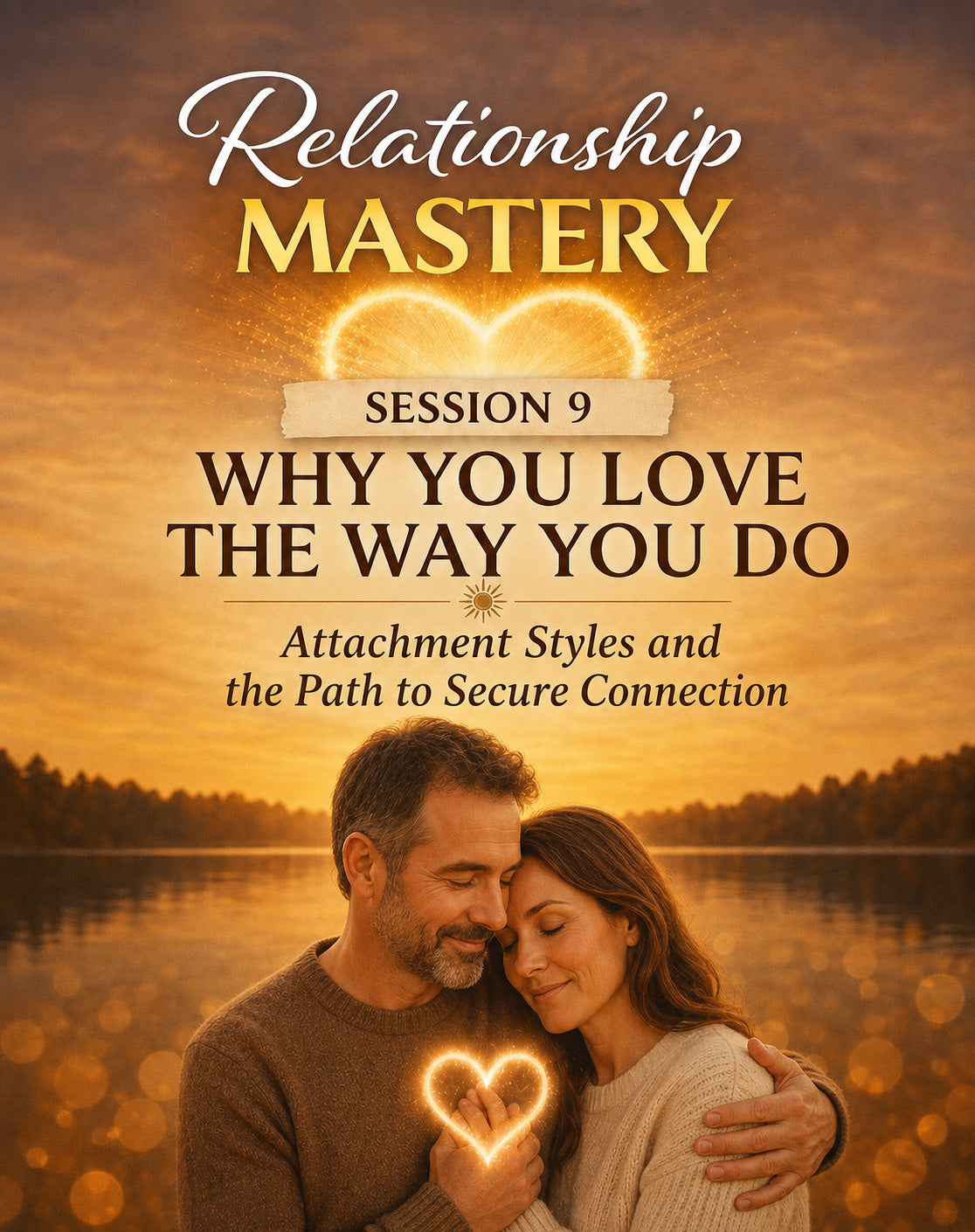
Why You Love the Way You Do
Attachment Styles & the Path to Secure Connection
You didn't choose the way you love.
Not really. Not the part that shows up when you're scared. Not the part that reaches out or pulls back. Not the part that clings when someone gets too close to leaving, or shuts down when someone asks for more than you know how to give. Not the part that needs constant reassurance, or the part that can't accept it no matter how much it's offered.
That part was shaped long before you had any say in the matter — in the earliest relationships of your life, with the people who were supposed to keep you safe, in the first months and years when your nervous system was learning, at a level far below language or conscious thought, what love was and how it worked.
You didn't choose it. But you've been living it ever since.
And the extraordinary thing — the thing this workshop is built around — is this: understanding how that learning happened is one of the most powerful steps you can take toward changing it.
The Science of How We Bond
In the 1950s and 60s, a British psychiatrist named John Bowlby made a discovery that would quietly revolutionize our understanding of human relationships. He found that the bonds formed between infants and their caregivers were not incidental to development — they were central to it. That the quality of those early attachments shaped not just childhood wellbeing, but the entire trajectory of how a person would relate to others across their lifetime.
His colleague Mary Ainsworth confirmed and extended his work — identifying, through a deceptively simple experiment called the Strange Situation, that children developed distinct and measurable patterns of attachment: secure, anxious, and avoidant. And she showed that these patterns were not random, but direct responses to the specific way each child had been cared for.
The decades that followed brought the work of Mary Main, who identified a fourth pattern — disorganized attachment — and showed that these early strategies didn't disappear in adulthood. They went underground. They became the blueprint for how we would navigate intimacy, conflict, vulnerability, and love for the rest of our lives.
Researchers Stan Tatkin, Sue Johnson, and Diane Poole Heller brought this work into adult relationships with stunning clarity — showing that what looks like a partner being clingy, cold, confusing, or controlling is almost always, at its root, an attachment system doing exactly what it was designed to do: trying to find safety in the only way it learned how.
This is not just theory. This is your relationship. And understanding it changes everything.
What We'll Explore Together
We begin with the four primary attachment styles — secure, anxious, avoidant, and disorganized — and what each one actually looks and feels like in adult relationships. Not as fixed labels or permanent diagnoses, but as maps: useful ways of understanding patterns that have been running beneath your awareness, often for decades.
You'll learn how your attachment style shapes your feelings in relationship — why certain emotional experiences feel unbearable to you while others barely register, why particular moments of closeness or distance carry a charge far out of proportion to what's actually happening in the present.
You'll explore how attachment styles shape needs — the specific things each style is most fundamentally longing for, often without being able to name or ask for them directly, and why getting those needs met in conscious, direct ways rather than through unconscious strategies is the path toward earned security.
You'll look at how attachment patterns show up as habitual relational responses — the pursue-withdraw dynamic that plays out in so many couples, the way anxious and avoidant styles find each other with an almost magnetic reliability, the self-defeating strategies each style employs in the very moments it most needs connection.
You'll be introduced to the concept of attunement — the practice of feeling felt, of truly sensing that another person is tracking your inner experience and responding to it with care. You'll understand why attunement is not just emotionally nourishing but neurologically regulating — why being truly met by another person can calm a nervous system that no amount of self-talk has been able to reach.
And then we move toward what is possible: the research-supported, profoundly hopeful concept of earned security — the finding, now well-established in the literature, that attachment patterns are not destiny. That adults can and do develop secure functioning in relationships, not by erasing the past, but by building new experiences of safety, consistency, and genuine connection that gradually — and sometimes surprisingly quickly — rewire the system.
You'll leave with practices for cultivating secure attachment in your own relationships — concrete ways of creating the conditions of safety, predictability, and mutual care that allow both people to gradually come home to something neither of them may have fully known before.
You'll Leave With:
- A clear, accessible understanding of the four attachment styles and how they show up in adult relationships — yours and your partner's
- Insight into how your attachment history shapes your feelings, your needs, and your automatic relational responses
- The ability to recognize the pursue-withdraw dynamic and other common attachment-driven patterns in your own relationships
- An understanding of attunement — what it is, why it matters, and what it feels like when it's present or absent
- The concept of earned security and why it means your past does not have to determine your future
- Practical starting points for cultivating more secure functioning in your most important relationships
- Compassion for yourself and for the people you love — grounded now in a genuine understanding of why you all love the way you do
Who This Workshop Is For
This session is for anyone who has ever wondered why their relationships follow the same patterns no matter how hard they try to change them.
It's for the anxious attacher who needs more reassurance than they feel they should — and whose need for it seems to push away the very connection they're reaching for. For the avoidant attacher who genuinely wants closeness but finds that something in them shuts down the moment it arrives. For the person whose attachment history is more complicated than either of those descriptions, and who has spent years trying to make sense of why intimacy feels simultaneously like the thing they most want and the thing they most fear.
It's for couples who want to understand each other's patterns with genuine curiosity rather than frustration — who want to stop taking each other's defenses personally and start seeing them for what they actually are.
It's for coaches and therapists who want a solid grounding in attachment theory as it applies to adult relationships — presented in a way that is both scientifically grounded and immediately accessible to people without a clinical background.
It's for anyone who has ever felt, in their most honest moments, that the way they love is somehow costing them the love they want — and who is ready to understand why, and what to do about it.
A Note from Your Facilitators
We come back to attachment theory again and again in our work — not because it's trendy, but because it explains so much that nothing else quite reaches.
The moment a couple understands their dynamic through the lens of attachment — when the anxious partner sees that their pursuing is not neediness but a nervous system trying desperately to restore safety, and the avoidant partner sees that their withdrawal is not coldness but a different nervous system trying to do exactly the same thing — something remarkable happens. The story changes. The enemy image dissolves. Two people who have been hurting each other for years suddenly see each other clearly, perhaps for the first time.
That moment of mutual understanding is one of the most moving things we witness in our work. And it is available to anyone willing to look honestly at where their patterns came from — and who they want to become.
You didn't choose the way you love. But after this session, you will have far more choice about how you love going forward.
— Scott Catamas & Katrina Vaillancourt, Love Coach Academy
Part of the Relationship Mastery 15-Week Training | Also available as a standalone workshop Saturdays, 9:00–11:00am PDT | Live on Zoom | Replay available
What People Are Saying


Becky, Workshop Participant“They’re magic—and cheaper than therapy.”
Marya Stark, Singer–Songwriter & Music Therapist“Katrina’s Love Smart Cards are my favorite deck to work with. They help me get clear in moments of tension—whether with a partner, a client, or my own heart.”
Rev. Patrick McCollum, International Peace Facilitator“These cards are a powerful peace-building tool—easy to use, ageless, and transformative. I’ve even shared them with members of the United Nations.”
Tanner Petrilla, Permaculture Expert“Time and time again, I lean on the Love Smart Cards in my personal life and relationship—they literally work miracles.”
Dan Hansen & Diana Perez, Relationship Coaches“We use them during conflict and they’ve saved us more than once—helping us feel heard, validated, and even discover the roots of old triggers.”