


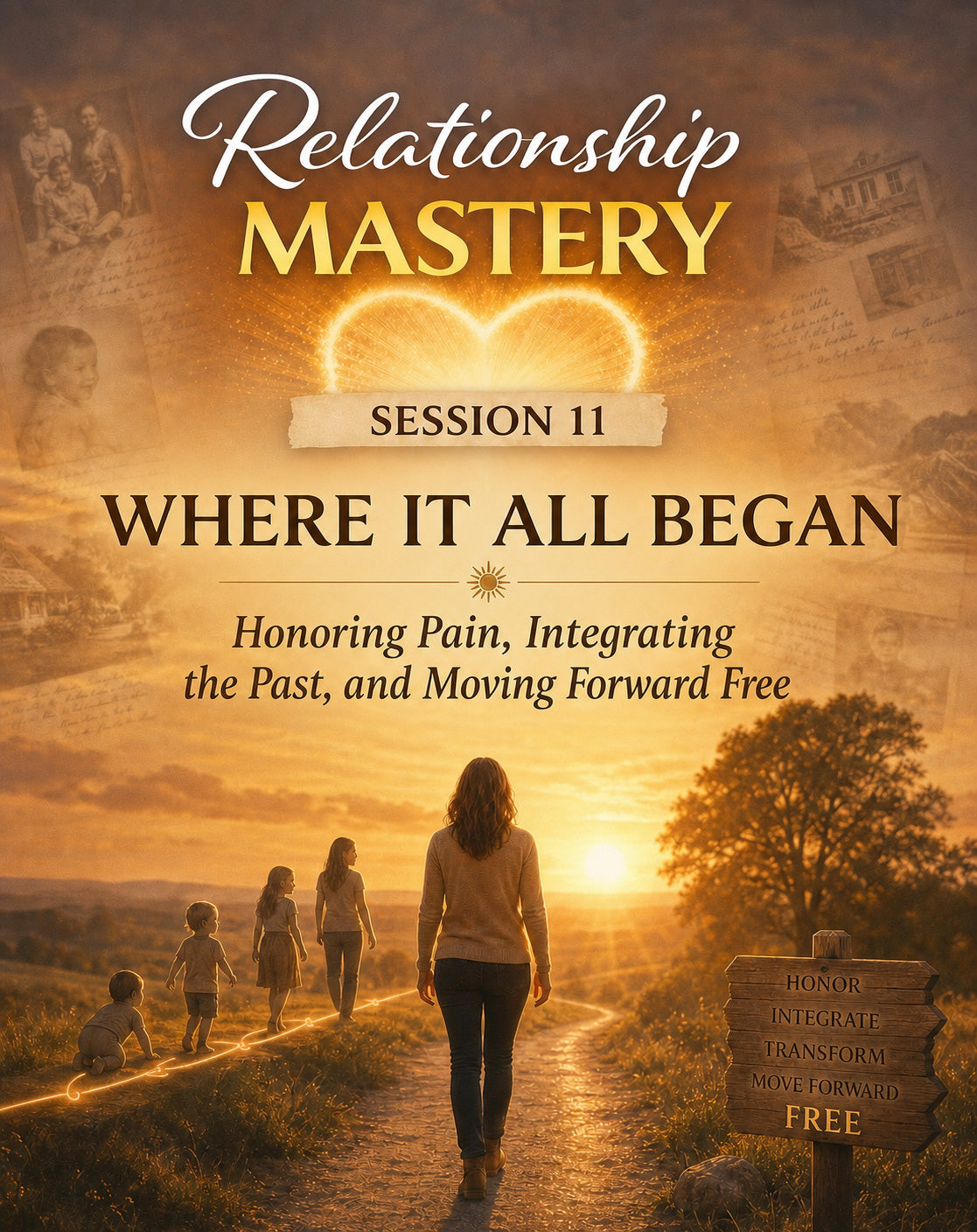
August 8 - Where It All Began: Honoring Pain, Integrating the Past & Moving Forward Free
- Regular price
-
$97.00 - Regular price
-
- Sale price
-
$97.00
Couldn't load pickup availability
Shipping information
Shipping cost is based on weight. Just add products to your cart and use the Shipping Calculator to see the shipping price.

Product Details
Saturday August 8, 9-11am PDT, 5-7pm UTC
with option to stay from 11-noon for Q&A, practice and small group coaching
(session 11 in a 15-week Relationship Mastery series)
Where It All Began
Honoring Pain, Integrating the Past & Moving Forward Free
There are wounds that don't announce themselves.
They don't arrive with a diagnosis or a clear origin story. They show up sideways — in the way you tense when a certain tone of voice enters the room, in the dream you keep having that you can't quite explain, in the disproportionate grief that ambushes you over something small. In the relationship that keeps ending the same way. In the love you keep almost having.
You've done the work. You've read the books. You understand, intellectually, that your past shapes your present. You can trace the outline of how it happened — the childhood that was too much, or not enough, or both at once. The parent who couldn't quite show up. The loss that never got properly mourned. The version of yourself you had to put away in order to survive.
You understand it. And still — it keeps showing up.
Because understanding a wound is not the same as healing it.
This workshop is about the difference.
Why the Past Keeps Arriving in the Present
The mind understands in language. It processes events into stories, assigns meaning, draws conclusions, and files them away. And this is genuinely useful — up to a point.
But the body keeps its own records.
Long after the mind has "made sense" of what happened, the nervous system holds the emotional residue of experiences that were never fully processed — moments of fear, grief, shame, or overwhelm that were too much to feel at the time, and so were stored rather than metabolized. Not forgotten. Not resolved. Simply waiting, in the body, for a safe enough moment to complete what couldn't be completed then.
This is why insight alone doesn't heal. Why you can know exactly where a pattern came from and still find yourself living it. Why couples can understand each other's attachment histories and still trigger each other in the same ways, again and again.
The past doesn't stay in the past because we understand it. It stays because we carry it — in our bodies, in our nervous systems, in the parts of us that learned, long ago, to brace against what might be coming.
What heals it is not more understanding. What heals it is presence — compassionate, embodied, unhurried presence with the experience itself, at a depth the mind alone cannot reach.
That is what this session is designed to offer.
What We'll Explore Together
We begin by looking at how past wounds live in present relationships — the specific ways unresolved pain from earlier in life bleeds into the dynamics of our adult connections. Not as abstract theory, but as something you'll recognize in your own experience: the trigger that's never quite made sense, the pattern that predates your current relationship, the feeling of being young again in the middle of an adult argument.
You'll be introduced to a trauma-informed, somatic framework for understanding how the body holds emotional experience — and why working with the body, not just the mind, is essential for genuine healing. You don't need a trauma history in the clinical sense to benefit from this. You simply need to be human — to have had experiences that were more than you knew how to feel at the time.
We'll work with the concept of subpersonalities — the inner cast of characters that develop within us as adaptive responses to early experiences. The part that learned to be endlessly capable so no one would see the fear underneath. The part that stays small to avoid taking up too much space. The part that became the peacekeeper, the achiever, the invisible one, the one who manages everyone else's feelings so skillfully they never had to feel their own. You'll begin to recognize these parts not as problems to be fixed but as protectors to be understood — and gradually, gently, to be updated.
We'll practice mourning — in the deep, NVC sense of the word: not the suppression of grief, not the performance of it, but the genuine, compassionate presence with loss that allows it to move through rather than calcify. The losses that most need mourning in this context are often not the dramatic ones — they are the quieter losses. The childhood that wasn't safe enough. The parent who couldn't give what you needed. The version of yourself you sacrificed in order to belong. The grief of what never got to be.
And then we arrive at the heart of the session: Roots & Rewrites — an original guided exercise developed specifically for this curriculum, and one of the most powerful practices in the entire fifteen-week journey.
Roots & Rewrites takes you gently back to the origin of a limiting belief or relational wound — not to relive it, but to meet it with something it never had at the time: your own adult presence, your compassion, and your capacity to offer the younger version of yourself what was missing. You'll identify where a core fear or conditioned response first took root, hold it with compassion rather than judgment, and begin the process of consciously rewriting the story — not by pretending it didn't happen, but by expanding what it means and what it requires of you going forward.
Participants consistently describe this as one of the most tender and freeing experiences of the entire program.
We'll close the session by exploring how conflict, when met with presence rather than reactivity, can become one of the most powerful pathways toward deeper connection — not in spite of the pain it surfaces, but because of it. The argument that keeps recurring is often not a sign that the relationship is failing. It is an invitation — from one nervous system to another — to finally tend to something that has needed tending for a very long time.
You'll Leave With:
- A clear understanding of why insight alone doesn't heal — and what does
- A trauma-informed, somatic framework for understanding how the body holds and releases emotional experience
- An introduction to subpersonalities — the inner parts that developed in response to early experiences — and how to work with them compassionately
- The practice of mourning as a tool for metabolizing grief that has been stored rather than processed
- The Roots & Rewrites guided exercise — one of the most powerful practices in this curriculum, available to you for ongoing personal work
- A new relationship with conflict: not as a sign that something is wrong, but as an invitation to tend to something that needs attention
- Practical tools for recognizing when the past is arriving in the present — and for responding with compassion rather than reactivity
- A felt sense of what it means to hold your own history with tenderness — and what becomes available when you do
Who This Workshop Is For
This session is for anyone who has ever had the disorienting experience of being in an adult relationship and suddenly, inexplicably, feeling very young.
It's for the person who understands their patterns but can't quite stop living them. For the one who has made peace with their past intellectually but still finds it showing up in their body — in their chest, their jaw, their impulse to flee or freeze or fight. For the partner who knows their current relationship is triggering something older, and who is ready to finally address what it actually is.
It's for anyone who is carrying grief that has never been fully honored — for a childhood, a parent, a version of themselves, a loss that happened too fast or too young or in a context where there was no room to feel it.
It's for coaches and therapists who want a structured, somatic, parts-informed approach to working with relational wounds — a framework that is accessible to clients without clinical backgrounds and yet rigorous enough to produce genuine healing rather than just emotional catharsis.
It's for anyone who is tired of their past arriving uninvited in their present — and ready not just to understand where it came from, but to do the work that finally, actually, sets them free.
A Note from Your Facilitators
We have held this session more times than we can count. And it never stops moving us.
There is something that happens in a room — or on a screen, because this work travels beautifully across distance — when people are given permission to stop managing their past and simply meet it. When they are invited to bring their adult self back to the moment where something first went wrong, not to rescue themselves from it, but to be present with the part of them that needed presence then and never quite got it.
We have watched people in this session make contact with parts of themselves they hadn't seen in decades. We have watched couples suddenly understand each other across years of confusion. We have watched people set down burdens they had been carrying so long they had stopped noticing the weight.
This is not dramatic work. It is not cathartic in the way people sometimes expect healing to be. It is quieter than that, and more lasting. It is the work of coming home to yourself — to all of yourself, including the parts that learned to stay hidden — and finding, perhaps for the first time, that it is safe to be whole.
Come gently. Come openly. And come ready to meet yourself in a new way.
— Scott Catamas & Katrina Vaillancourt, Love Coach Academy
Part of the Relationship Mastery 15-Week Training | Also available as a standalone workshop Saturdays, 9:00–11:00am PDT | Live on Zoom | Replay available
What People Are Saying


Becky, Workshop Participant“They’re magic—and cheaper than therapy.”
Marya Stark, Singer–Songwriter & Music Therapist“Katrina’s Love Smart Cards are my favorite deck to work with. They help me get clear in moments of tension—whether with a partner, a client, or my own heart.”
Rev. Patrick McCollum, International Peace Facilitator“These cards are a powerful peace-building tool—easy to use, ageless, and transformative. I’ve even shared them with members of the United Nations.”
Tanner Petrilla, Permaculture Expert“Time and time again, I lean on the Love Smart Cards in my personal life and relationship—they literally work miracles.”
Dan Hansen & Diana Perez, Relationship Coaches“We use them during conflict and they’ve saved us more than once—helping us feel heard, validated, and even discover the roots of old triggers.”