


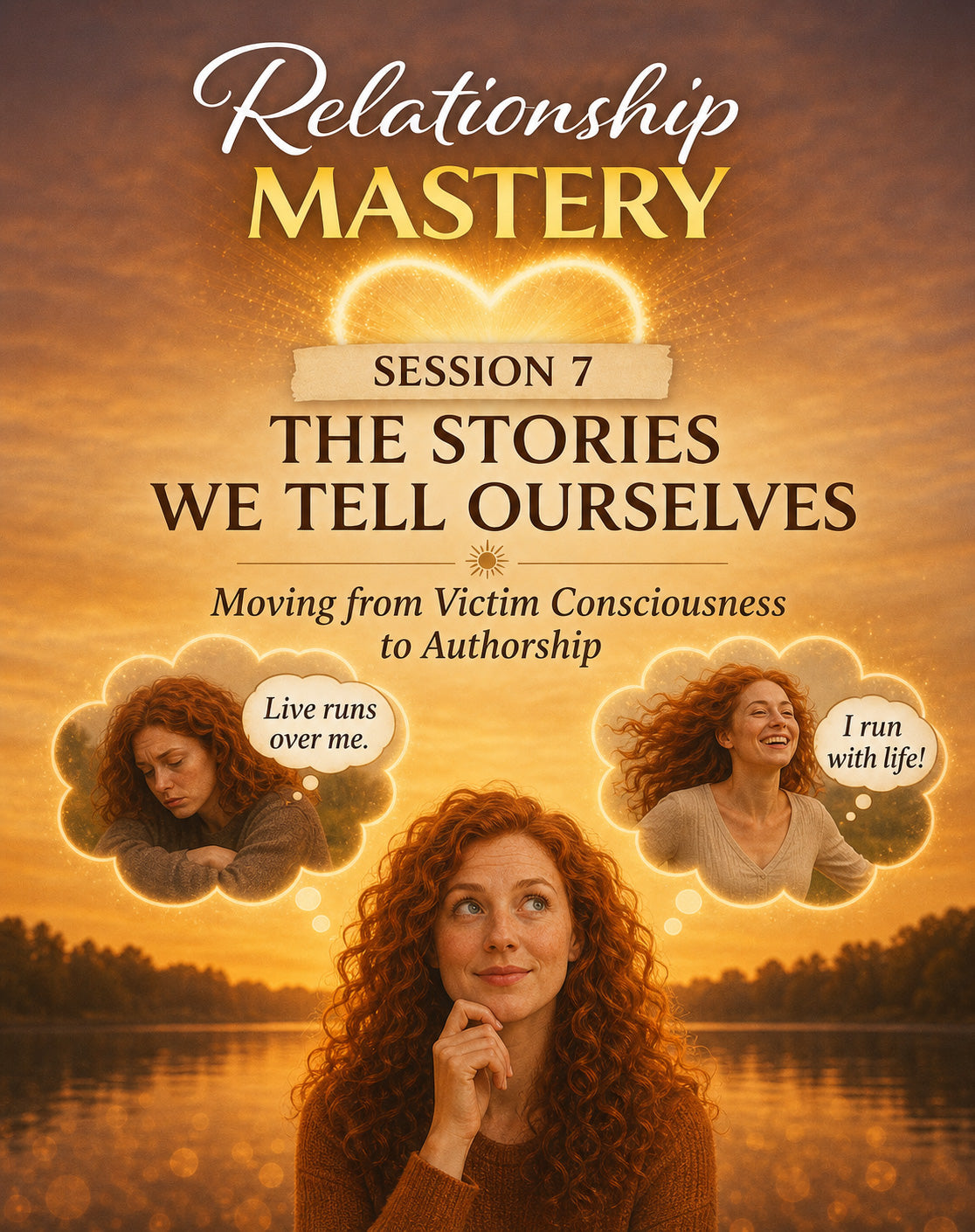
The Stories We Tell Ourselves: Moving from Victim Consciousness to Authorship (Recorded workshop #7 in the Relationship Mastery Series))
- Regular price
-
$47.00 - Regular price
-
- Sale price
-
$47.00
Couldn't load pickup availability
Shipping information
Shipping cost is based on weight. Just add products to your cart and use the Shipping Calculator to see the shipping price.

Product Details
The Stories We Tell Ourselves
Moving from Victim Consciousness to Authorship
There's a story running in the background of most of our relationships.
It's the story where we're doing our best and they keep getting it wrong. Where we've tried everything and nothing works. Where the same things keep happening to us — the same disappointments, the same betrayals, the same feeling of being unseen, unheard, unappreciated — because of something outside of us. Our partner. Our past. Our circumstances. Our luck.
It's a convincing story. Parts of it are probably even true.
But here's what nobody tells you about that story: as long as you're in it, you're powerless. Not because of anything they did. Because of the story itself.
This workshop is about finding the exit.
The Most Honest Thing We Can Say About Victim Consciousness
Victim consciousness is not a character flaw. It is not something that only weak or unaware people experience. It is a deeply human response to pain — a way the mind protects itself from the unbearable weight of full responsibility by distributing some of it outward.
We have all been there. Some of us live there.
And the painful irony is this: the same story that feels like protection is also the thing that keeps us stuck. Because as long as the problem is out there — in them, in the past, in the circumstances — the solution is also out there. Out of reach. Waiting on someone else to change.
The moment we begin to question the story — not to deny our pain, not to pretend things didn't happen, not to let anyone off the hook — but to honestly examine the role we're playing in how things continue — that is the moment everything becomes possible.
That moment is what this session is designed to create.
What We'll Explore Together
We begin with language — because the way we talk about our experience is not just a symptom of how we see things. It is part of how we create what we see.
You'll learn to recognize evaluations masquerading as feelings — the words we reach for when we say "I feel like you never care" or "I feel attacked" or "I feel that you're being unfair." These are not feelings. They are judgments dressed in feeling language — and they locate the problem squarely in the other person while keeping us safely out of view. Learning to distinguish them is one of the most quietly revolutionary skills in this entire curriculum.
We'll look at thoughts mixed with evaluations — the way our mind bundles observations, interpretations, and verdicts together so seamlessly that we mistake the whole package for reality. By the time we've decided what something means, we've long since stopped seeing what's actually there.
We'll examine the power of narrative — the stories we construct about ourselves, about others, about what relationships are and what we deserve from them — and how those stories, once formed, become self-fulfilling. Not because the universe is conspiring to prove us right, but because we unconsciously act in ways that make the story come true.
Then we go to the heart of it: the victim/perpetrator/rescuer triangle — one of the most illuminating maps of human relational dynamics ever developed. You'll see how we move between these roles — sometimes in the space of a single conversation — and how each role, while feeling justified in the moment, keeps everyone in the system stuck. And you'll learn the turn-arounds: the specific shifts in perspective that allow you to step out of the triangle entirely and into something more honest, more free, and more powerful.
We'll work with the distinction between habits of disowning — the ways we externalize, deflect, minimize, and project our experience — and practices of owning: the courageous, sometimes uncomfortable act of claiming full authorship of your thoughts, your feelings, your needs, and your choices.
And we'll explore what authentic relating actually looks like and feels like — not as an abstract ideal, but as a lived practice: what it means to show up in a conversation as the author of your own experience, accountable for your part, curious about theirs, and genuinely open to something new.
You'll Leave With:
- The ability to recognize evaluations masquerading as feelings — and why making this distinction changes the entire quality of your communication
- A clear understanding of how thoughts and evaluations become bundled into narratives that shape what we see and what becomes possible
- A working knowledge of the victim/perpetrator/rescuer triangle — and the turn-arounds that allow you to step free of it
- Practical tools for moving from habits of disowning to practices of owning your full experience
- A felt sense of what authentic relating looks and feels like — and how different it is from the defended, story-filtered relating most of us default to
- A renewed relationship with personal responsibility — not as burden or blame, but as the only genuine source of freedom available to us
- Greater capacity to stay in honest, empowered contact with your own experience even when that experience is uncomfortable
Who This Workshop Is For
This session is for anyone who has ever felt trapped in a relational pattern they couldn't seem to escape — and suspected, somewhere beneath the story, that they might be part of why.
It's for the person who knows they're holding grievances they can't quite put down. For the one who keeps finding themselves in the same dynamic with different people. For the partner who is exhausted from feeling like the only one trying. For anyone who has ever said — out loud or silently — why does this always happen to me?
It's for coaches and therapists who want a rigorous, compassionate framework for working with victim consciousness in their clients — one that doesn't shame or confront, but gently and skillfully invites the shift from powerlessness to authorship.
It's for anyone who is ready to stop waiting for the story to change on its own — and willing to consider that they might be the one who gets to write what happens next.
A Note from Your Facilitators
This is the session that people most often tell us changed something fundamental.
Not because it's the most dramatic. Not because it's the most emotional. But because it tells the truth about something most of us have been quietly carrying for a long time — the suspicion that we are more involved in our own suffering than we've been willing to admit.
That suspicion, when it finally gets named out loud and met with compassion rather than shame, becomes something extraordinary. It becomes power. It becomes choice. It becomes the beginning of a way of living in relationship that is no longer organized around protection and blame, but around honesty and genuine contact.
We will not shame you in this session. We will not tell you that your pain isn't real or that the things that happened to you don't matter. We will simply offer you a larger story — one in which you are not the victim of your life, but the author of it. And we will ask you, gently and seriously, what you would like to write next.
— Scott Catamas & Katrina Vaillancourt, Love Coach Academy
Part of the Relationship Mastery 15-Week Training