


July 11 - From Harsh to Heart: Turning Blame, Shame & Judgment into Compassionate Understanding
- Regular price
-
$97.00 - Regular price
-
- Sale price
-
$97.00
Couldn't load pickup availability
Shipping information
Shipping cost is based on weight. Just add products to your cart and use the Shipping Calculator to see the shipping price.

Product Details
Saturday July 11, 9-11am PDT, 5-7pm UTC
with option to stay from 11-noon for Q&A, practice and small group coaching
(session 8 in a 15-week Relationship Mastery series)
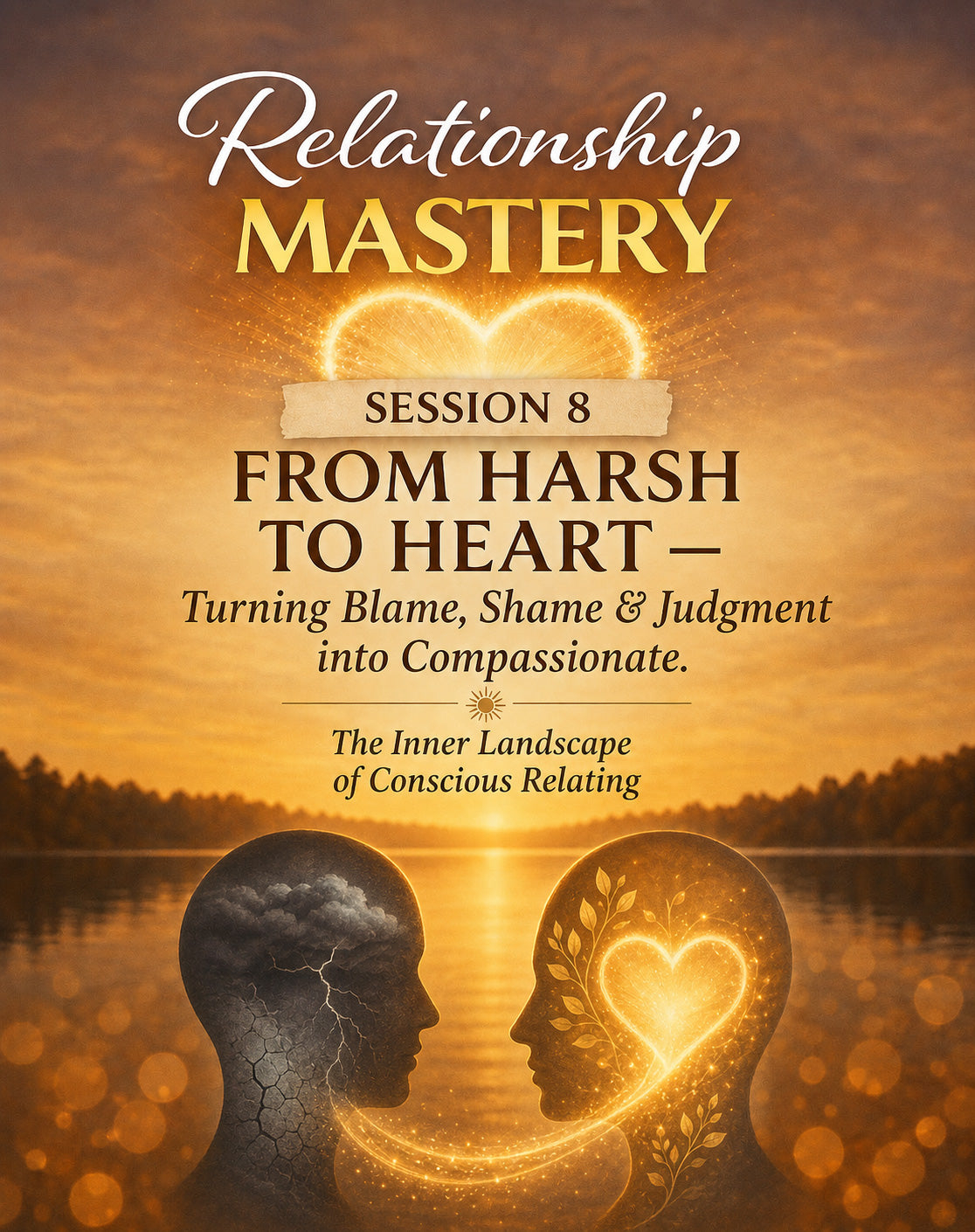
From Harsh to Heart
Turning Blame, Shame & Judgment into Compassionate Understanding
Listen, for a moment, to the voice inside your head.
Not the one that's reading these words. The other one. The one that shows up when you make a mistake. When you say the wrong thing. When you look in the mirror on a hard day. When you let someone down — or when someone lets you down.
What does that voice sound like?
For most of us, it sounds like a critic. A judge. A prosecutor with an airtight case and no interest in mercy. It speaks in absolutes — always, never, should, shouldn't. It delivers verdicts without trials. It specializes in shame.
And here is what almost nobody talks about: that voice is not just an inner experience. It is a relational one. Because the way you speak to yourself — the harshness, the blame, the relentless judgment — leaks. It shapes the way you listen to others. It determines how quickly you forgive. It colors every interpretation you make of the people closest to you. It creates a baseline of criticism that you swim in so constantly you've stopped noticing it's there.
But there's another side to this, one that is equally important and far less often taught.
What happens when the harsh voice isn't yours — but theirs?
When you are on the receiving end of someone else's blame, shame, or judgment — a partner's contempt, a parent's criticism, a colleague's attack — most of us either collapse into it, fight back against it, or shut down entirely. We take it personally, because it feels personal. We absorb it, because we don't yet have the tools to do anything else.
This workshop is about both directions at once. Because real freedom from the cycle of blame and judgment requires that you learn to work with harshness wherever it lives — inside you, outside you, and in the charged space between you and the people you love most.
What you practice inside becomes what you practice outside. And what you can hold with compassion in yourself, you can begin to hold with compassion in others.
The Critic Is Not the Enemy — Yours or Theirs
Before we try to silence the inner critic, we need to understand it.
The critical voice didn't arrive from nowhere. It was learned — in classrooms, in families, in cultures that used shame and judgment as primary tools of correction. It came from people who were themselves criticized, who were taught that harshness was discipline, that blame was accountability, that judgment was discernment.
And underneath all of that — underneath every harsh word the inner critic has ever delivered — is something that looks, when you finally get close enough to see it clearly, a great deal like love. A desperate, unskilled, sometimes brutal attempt to protect you from failure, rejection, and pain.
This is true of your inner critic. And it is equally true of theirs.
When someone directs blame or judgment at you — when they lash out, criticize, shame, or make you wrong — they are not, at their core, expressing strength. They are expressing pain. They are speaking the only language they currently have for needs that are not being met, for fears that are running the show, for a hurt that has not yet found its way into honest expression.
Understanding this does not mean accepting mistreatment. It does not mean staying in the room when you need to leave, or agreeing with a verdict that isn't true. It means that you are no longer at the mercy of their harshness — because you can see through it to what it actually is.
That seeing is the beginning of genuine compassion. And genuine compassion, it turns out, is also the most powerful protection there is.
What We'll Explore Together
We begin with self-negation — the specific ways most of us have learned to turn against ourselves: the self-criticism that follows a mistake, the shame spiral that makes a single misstep feel like evidence of fundamental unworthiness, the habit of making ourselves small before anyone else gets the chance to do it for us.
You'll learn the practice of turning self-negation around — not through toxic positivity or empty affirmation, but through a genuine process of translation: taking the harsh inner verdict and asking what need it's actually pointing toward, what value it's trying to protect, what more compassionate and useful version of the same message might sound like.
We'll then move into one of the most practically transformative skills in this entire curriculum: the art of translating blame, shame, criticism, make-wrong, and judgment — both internal and interpersonal — into the language of feelings, needs, and compassionate understanding.
This translation works in both directions.
When you are the one being critical — of yourself or others — you'll learn to ask: what am I actually feeling? What do I actually need? What would I say if I dropped the verdict and spoke from the wound instead?
And when someone else is directing their harshness toward you — when you are standing in the crossfire of their blame, their contempt, their judgment — you'll learn to ask a different set of questions: what might they be feeling beneath this? What need is so unmet that it's coming out this way? What would I hear if I listened past the attack to the person behind it?
This is not naivety. It is not the same as agreeing with what they're saying or absorbing it as truth. It is the skill of translating someone else's harshness in real time — finding the frightened, unmet need beneath the sharp edge of their words — so that you are responding to the human being rather than reacting to the attack.
You'll practice reframing the inner critic's verdicts — learning to hear "you're so stupid" as a signal of fear, "you always ruin everything" as an expression of longing, "they never appreciate you" as a need for recognition. Not because these reframes are more comfortable, but because they are more accurate — and because they open doors that judgment keeps permanently shut.
And you'll practice the same reframing when those words come from outside: hearing "you never think about anyone but yourself" as a longing for care and consideration; hearing "you're impossible" as the sound of someone at the end of their rope, not a factual assessment of who you are.
We'll explore how the inner voice shapes the way we listen — how a person who speaks harshly to themselves tends to hear criticism where none was intended, defensiveness where curiosity was offered, rejection where ambiguity existed. And how the same shift in inner practice that softens the voice in your head also softens the ear through which you hear the world — including the words that are aimed directly at you.
We'll look at the specific practice of attuning — to yourself and to others — with the quality of care and presence that allows real understanding to happen. Not the performance of understanding. Not nodding while you prepare your rebuttal. But the genuine turning of your full attention toward what is alive in another person, and what is alive in you, with equal and unhurried curiosity.
And we'll work with compassion as a skill — not a feeling you wait to have, but a capacity you develop and bring deliberately into the moments that most need it. Compassion for the critic in your own head. Compassion for the critic standing in front of you. And compassion for yourself as you learn to hold both — without collapsing, without defending, without losing the thread back to your own truth.
You'll Leave With:
- A clear understanding of where the inner critic comes from — yours and others' — and why fighting it has never worked
- The ability to recognize self-negation in real time and translate it into the language of needs and values
- Practical tools for reframing blame, shame, criticism, make-wrong, and judgment — both from within yourself and directed at you by others
- The skill of translating someone else's harshness in real time: finding the need beneath the attack so you can respond to the person rather than react to the words
- A new understanding of how your inner voice shapes your outer listening — and what becomes possible when you change the former
- The practice of attunement: what it feels like to truly turn toward another person with full, unhurried presence — even when that person is being difficult
- Greater access to compassion as a deliberate practice: for yourself, for others, and for the charged space between you
- A felt shift in the baseline quality of your inner life — less prosecutorial, more curious; less harsh, more human — and a new steadiness when harshness comes toward you from the outside
Who This Workshop Is For
This session is for anyone who has a complicated relationship with their own inner voice — and anyone who has ever been on the receiving end of someone else's.
It's for the person who would never speak to a friend the way they speak to themselves. For the one whose self-criticism runs so deep and so constant they've mistaken it for realism. For the partner who finds themselves hearing everything through a filter of suspicion or hurt, and wonders where the openness went.
It's for the person who knows they're hard on others — quick to judge, slow to forgive — and suspects that the harshness starts somewhere inside, long before it reaches their lips.
It's for the one who regularly absorbs a partner's or parent's blame and criticism, and hasn't yet found a way to hold it with compassion without being flattened by it.
It's for coaches and therapists who work with clients trapped in shame and self-criticism — or clients who are navigating the emotional fallout of being criticized, blamed, or shamed by the people they love — and who want richer language and more precise tools for helping people move from self-punishment and reactivity into genuine understanding and care.
It's for anyone who is exhausted from carrying a critic on their shoulder every waking hour — and ready to discover what life feels like when that voice begins, finally, to soften. In your head. And in the room.
A Note from Your Facilitators
We have never met a person whose inner critic was wrong about everything.
The things it points to — the fears it names, the needs it circles, the values it is, in its clumsy and painful way, trying to protect — are almost always real. The problem is never the concern. It's the delivery.
And the same is true of the critics who stand outside us — the partners, parents, and others whose blame and judgment have landed on us over the years and taken up residence in our nervous systems long after the conversation ended.
Blame and shame are the least efficient change agents in the known universe. They create defensiveness, contraction, and avoidance — in ourselves and in the people we direct them toward. They have never, in the history of human relationship, produced the lasting transformation they promise.
Compassionate understanding, on the other hand — the kind that sees clearly, names honestly, and holds the whole person with care — changes people. Not because it is soft. But because it is true. And because, when someone finally feels genuinely understood rather than judged, something in them relaxes enough to actually move.
This session is an invitation to practice that kind of understanding — starting with yourself, and extending it outward, even to the ones who are making it hardest.
— Scott Catamas & Katrina Vaillancourt, Love Coach Academy
Part of the Relationship Mastery 15-Week Training | Also available as a standalone workshop Saturdays, 9:00–11:00am PDT | Live on Zoom | Replay available
What People Are Saying


Becky, Workshop Participant“They’re magic—and cheaper than therapy.”
Marya Stark, Singer–Songwriter & Music Therapist“Katrina’s Love Smart Cards are my favorite deck to work with. They help me get clear in moments of tension—whether with a partner, a client, or my own heart.”
Rev. Patrick McCollum, International Peace Facilitator“These cards are a powerful peace-building tool—easy to use, ageless, and transformative. I’ve even shared them with members of the United Nations.”
Tanner Petrilla, Permaculture Expert“Time and time again, I lean on the Love Smart Cards in my personal life and relationship—they literally work miracles.”
Dan Hansen & Diana Perez, Relationship Coaches“We use them during conflict and they’ve saved us more than once—helping us feel heard, validated, and even discover the roots of old triggers.”