


August 1: Feed the Love: Appreciation, Rituals & the Art of Nourishing Your Relationship
- Regular price
-
$97.00 - Regular price
-
- Sale price
-
$97.00
Couldn't load pickup availability
Shipping information
Shipping cost is based on weight. Just add products to your cart and use the Shipping Calculator to see the shipping price.

Product Details
Saturday August 1, 9-11am PDT, 5-7pm UTC
with option to stay from 11-noon for Q&A, practice and small group coaching
(session 10 in a 15-week Relationship Mastery series)
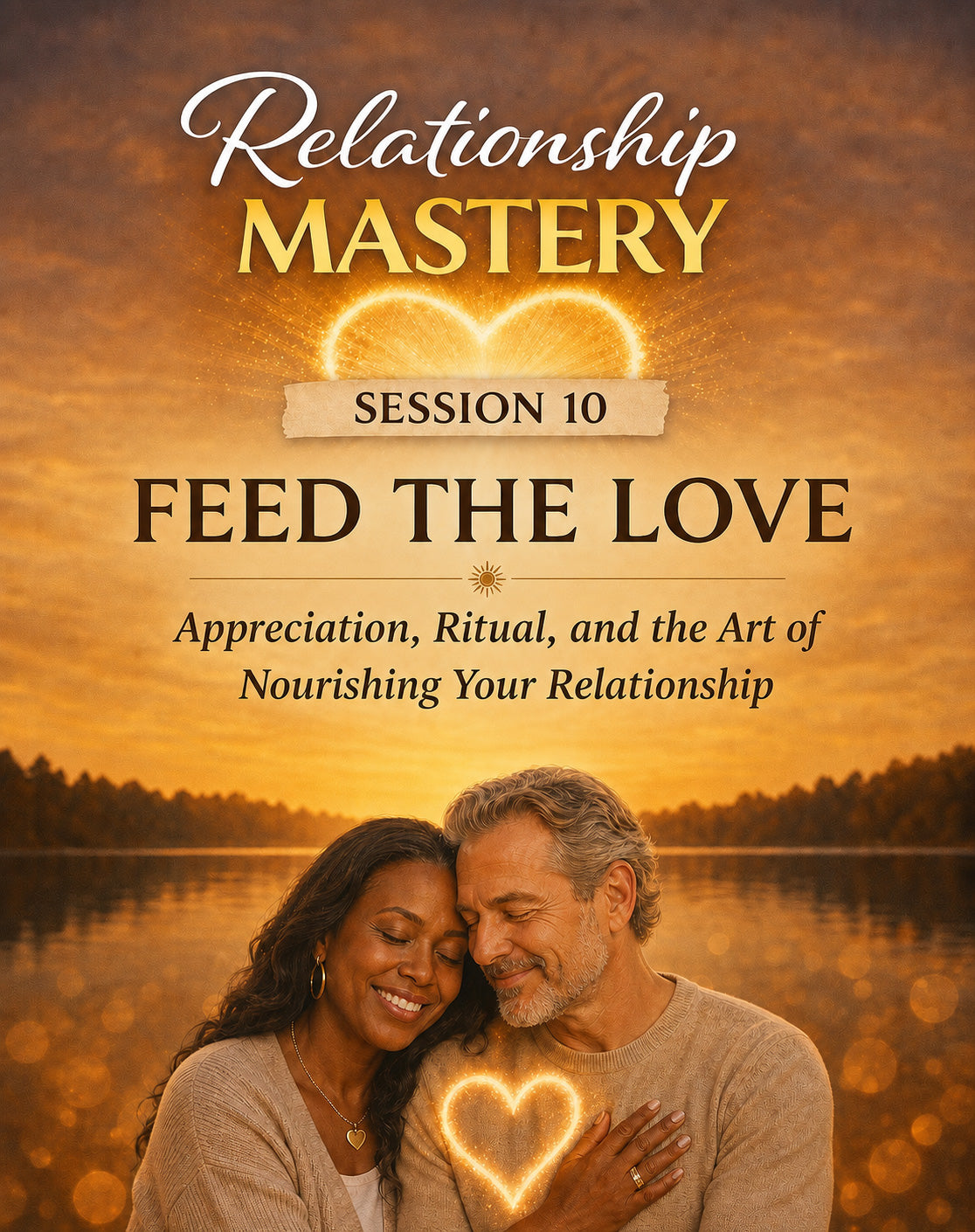
Feed the Love
Appreciation, Rituals & the Art of Nourishing Your Relationship
Most relationships don't end dramatically.
They don't end in a single catastrophic fight, a devastating betrayal, or a moment of irreversible rupture. They end the way a plant dies when nobody remembers to water it. Slowly. Quietly. Through a thousand small moments of neglect — not malicious, not intentional, just... absent.
The morning kiss that stopped happening. The question "how was your day?" that became a formality rather than a genuine invitation. The inside jokes that faded. The appreciation that was felt but never spoken. The rituals that held you together during harder times, quietly abandoned when life got busy.
Nobody decided to stop nourishing the relationship. Life simply expanded to fill every available space, and the tending — the deliberate, loving, daily tending — got crowded out.
And then one day you look across the room at the person you chose, and feel, beneath the familiarity, a distance you're not quite sure how to close.
This session is about closing it. Before it opens. Or after it already has.
What the Research Actually Shows
In the 1970s, a young psychologist named John Gottman began doing something no one had quite done before: he brought couples into a laboratory and watched them interact. Not in crisis. Not in therapy. Just talking — about their day, about a conflict, about a dream. And he filmed it, coded it, and followed those couples for years.
What he found was both simple and staggering.
It wasn't the intensity of the conflicts that predicted whether a couple would stay together. It wasn't compatibility, shared values, or even how much they loved each other. The single most powerful predictor of relationship stability and satisfaction was something far more ordinary: the ratio of positive to negative interactions in everyday life.
Couples who stayed together and reported genuine happiness — what Gottman called the "Masters" of relationship — maintained a ratio of approximately five positive interactions for every one negative. Not because they never fought, never disappointed each other, never had hard days. But because they had built, through consistent daily practice, a deep reservoir of goodwill, warmth, and genuine connection that could hold the weight of difficulty when it came.
The couples who struggled — those Gottman called the "Disasters" — were often not dramatically different in the content of their conflicts. They simply hadn't built the reservoir. The ratio had slipped. And without that foundation of accumulated positive connection, every difficulty felt like a crisis, every conflict felt existential, every imperfection felt like evidence that something was fundamentally wrong.
This finding changes the question. The question is not: how do we have fewer conflicts? It is: how do we nourish the relationship so richly that it can hold the conflicts we will inevitably have?
That is what this session is about.
What We'll Explore Together
We begin with Gottman's 5:1 ratio — not just as a concept, but as a living practice. You'll look honestly at the current ratio in your most important relationships and begin to understand specifically what shifts when that ratio is out of balance — and what becomes possible when it's restored.
We'll explore the profound difference between appreciation and acknowledgment — two things that sound similar but function very differently in relationship. A passing thank-you is transactional. Genuine appreciation — the kind that names specifically what someone did, how it made you feel, and what need it met for you — is an act of deep seeing. It says: I notice you. I value you. What you do matters to me. And it lands in the nervous system of the receiver as something close to love.
You'll learn the practice of mournings and celebrations — one of the most deceptively simple and profoundly connecting practices in this entire curriculum. The act of sharing what you are grieving and what you are celebrating, regularly and with genuine presence, creates a quality of intimacy that most couples spend years searching for and never quite find. Because it requires — and therefore builds — exactly the kind of vulnerability, attention, and mutual care that intimacy is actually made of.
We'll explore reassurance — what it genuinely means to offer comfort to someone in a moment of vulnerability. Not the reflexive "you'll be fine" that closes the conversation before it opens, but the kind of attuned, specific, present reassurance that reaches the frightened or uncertain place in another person and says: I see you. You are not alone. I am here.
You'll be introduced to the Five Love Languages — Gary Chapman's enduringly useful framework for understanding that people give and receive love in fundamentally different ways, and that what feels like love to you may not register as love at all to the person you're offering it to. Understanding your own primary love language — and your partner's — is not just interesting. It is practically transformative in the daily texture of how you show up for each other.
We'll look at the extraordinary power of relationship rituals — the small, repeated practices that create the connective tissue of a shared life. Morning check-ins. Weekly date nights with a real question rather than a restaurant menu. A particular way of saying goodbye. A practice of naming one thing you appreciate about each other before sleep. These are not trivial. Research consistently shows that couples who maintain intentional rituals of connection report significantly higher levels of satisfaction, resilience, and felt closeness — because rituals do something that grand gestures cannot: they show up every day.
And we'll explore authentic relating — practices and games designed to create genuine contact and aliveness in relationship, the kind of real presence with another person that reminds you both why you chose this, why it matters, and what's possible when you stop performing and start actually meeting each other.
You'll Leave With:
- A clear understanding of Gottman's 5:1 ratio and how to use it as a practical diagnostic and guide for your own relationships
- The ability to offer appreciation and acknowledgment at a depth that genuinely lands — specific, felt, and connecting
- The mournings and celebrations practice as a tool for building intimacy quickly and sustainably
- A new understanding of reassurance — what it actually is and how to offer it in a way that reaches the person you're trying to reach
- Your own love language profile and a working understanding of your partner's — with practical implications for how you show up daily
- A repertoire of relationship rituals you can begin implementing immediately
- An introduction to authentic relating practices that create aliveness, presence, and genuine contact
- A felt sense of what a consistently nourished relationship feels like — and a concrete path toward building one
Who This Workshop Is For
This session is for anyone who loves someone and wants to love them better — in the daily, unglamorous, extraordinarily important ways that actually sustain a relationship over time.
It's for the long-term couple who has let the small gestures slip and feels the distance that's accumulated in their absence. For the new couple who wants to build the right habits from the beginning rather than trying to recover them later. For the individual who has realized that they give love in the way they want to receive it — rather than in the way their partner actually experiences it.
It's for anyone who has ever felt deeply loving toward someone but somehow failed to make them feel loved. For anyone who has felt unloved by someone who was, in their own way, trying very hard.
It's for coaches and therapists who want practical, research-backed tools for helping clients build the relational foundation that makes all other growth possible — because the skills taught in every other session of this curriculum are significantly easier to learn and sustain when the underlying reservoir of goodwill is full.
It's for anyone who is ready to stop leaving the nourishment of their most important relationship to chance — and willing to treat love not as something that happens to you, but as something you actively, deliberately, and joyfully create.
A Note from Your Facilitators
This is one of the sessions we love teaching most.
Not because it's the deepest or the most intense — it isn't. But because there is something quietly extraordinary about watching people remember what drew them to each other in the first place. About seeing a couple rediscover playfulness they thought they'd lost, or hearing someone articulate an appreciation for their partner that they'd been carrying silently for years, and watching the receiver's face change when they finally hear it.
The tools in this session are not complicated. They do not require a particular level of emotional development, or years of inner work, or the resolution of every conflict that came before. They simply require intention and practice — the willingness to show up, again and again, in the small ways that turn out to matter most.
Love is not just a feeling. It is a practice. And like every practice, it deepens in proportion to the attention and care you bring to it.
This session is an invitation to bring more.
— Scott Catamas & Katrina Vaillancourt, Love Coach Academy
Part of the Relationship Mastery 15-Week Training | Also available as a standalone workshop Saturdays, 9:00–11:00am PDT | Live on Zoom | Replay available
What People Are Saying


Becky, Workshop Participant“They’re magic—and cheaper than therapy.”
Marya Stark, Singer–Songwriter & Music Therapist“Katrina’s Love Smart Cards are my favorite deck to work with. They help me get clear in moments of tension—whether with a partner, a client, or my own heart.”
Rev. Patrick McCollum, International Peace Facilitator“These cards are a powerful peace-building tool—easy to use, ageless, and transformative. I’ve even shared them with members of the United Nations.”
Tanner Petrilla, Permaculture Expert“Time and time again, I lean on the Love Smart Cards in my personal life and relationship—they literally work miracles.”
Dan Hansen & Diana Perez, Relationship Coaches“We use them during conflict and they’ve saved us more than once—helping us feel heard, validated, and even discover the roots of old triggers.”